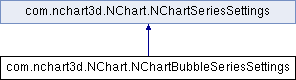
The NChartBubbleSeries.Settings class provides global settings for com.nchart3d.NChart.NChartBubbleSeries. More...
Public Member Functions | |
| int | gasSimulationIterations () |
| Maximal number of iterations in the quasi-physical gas simulation algorithm. More... | |
| void | setGasSimulationIterations (int gasSimulationIterations) |
| For details see gasSimulationIterations(). | |
| float | gasSimulationRepulsionFactorX () |
| Repulsion factor in X direction of quasi-physical gas simulation algorithm. More... | |
| void | setGasSimulationRepulsionFactorX (float gasSimulationRepulsionFactorX) |
| For details see gasSimulationRepulsionFactorX(). | |
| float | gasSimulationRepulsionFactorY () |
| Repulsion factor in Y direction of quasi-physical gas simulation algorithm. More... | |
| void | setGasSimulationRepulsionFactorY (float gasSimulationRepulsionFactorY) |
| For details see gasSimulationRepulsionFactorY(). | |
| float | gasSimulationRepulsionFactorZ () |
| Repulsion factor in Z direction of quasi-physical gas simulation algorithm. More... | |
| void | setGasSimulationRepulsionFactorZ (float gasSimulationRepulsionFactorZ) |
| For details see gasSimulationRepulsionFactorZ(). | |
| float | gasSimulationRepulsionFactorW () |
| General repulsion factor of quasi-physical gas simulation algorithm. More... | |
| void | setGasSimulationRepulsionFactorW (float gasSimulationRepulsionFactorW) |
| For details see gasSimulationRepulsionFactorW(). | |
Public Member Functions inherited from com.nchart3d.NChart.NChartSeriesSettings | |
| NChartSeriesSettings () | |
| Create instance of settings. | |
| boolean | isRudimentEnabled () |
| Flag determining if rudiment is allowed. More... | |
| void | setRudimentEnabled (boolean isRudimentEnabled) |
| For details see isRudimentEnabled(). | |
Detailed Description
The NChartBubbleSeries.Settings class provides global settings for com.nchart3d.NChart.NChartBubbleSeries.

Member Function Documentation
|
inline |
Maximal number of iterations in the quasi-physical gas simulation algorithm.
The default value is 300. Increase this value, if you want bubbles to wiggle longer. Decrease this value, if you want them to stop sooner. Note: this value does not affect the performance of a single frame rendering, but it affects the number of frames chart draws over time. So, bigger numbers can increase the energy consumption of your app.
|
inline |
General repulsion factor of quasi-physical gas simulation algorithm.
The default value is 1. If you want bubbles to fly apart, increase this value, otherwise decrease it to make them stick together more tightly.
|
inline |
Repulsion factor in X direction of quasi-physical gas simulation algorithm.
The default value is 1. The X component of repulsion force is multiplied by this value, so if you want bubbles not to be distributed along the X axis, decrease this value, for example to 0.1.
|
inline |
Repulsion factor in Y direction of quasi-physical gas simulation algorithm.
The default value is 1. The Y component of repulsion force is multiplied by this value, so if you want bubbles not to be distributed along the Y axis, decrease this value, for example to 0.1.
|
inline |
Repulsion factor in Z direction of quasi-physical gas simulation algorithm.
The default value is 1. The Z component of repulsion force is multiplied by this value, so if you want bubbles not to be distributed along the Z axis, decrease this value, for example to 0.1.

Public Member Functions inherited from